
A weak meta description is killing your click-through rate. You can rank on page one and still get ignored when your snippet fails to grab attention. Without a strong description, your content stays invisible while competitors take the clicks.
In fact, 90.63% of web pages get no organic traffic from Google, often due to poor visibility in search results. Every missed click is a lost opportunity. A well-written meta description can change that fast. It improves click-through rate and signals relevance to Google, turning impressions into real traffic.
If one short line can impact your results, are you making every character count?
What Is A Meta Description?
A meta description is an HTML tag (120-160 characters) that provides a concise summary of a webpage’s content. It appears below the title in search engine results (SERPs) to encourage users to click. While it doesn’t directly impact search rankings, a compelling meta description can improve click-through rates (CTR), which can indirectly boost SEO.
To create effective meta descriptions, use active voice, include relevant keywords, and ensure each page is unique.
6 Best Practices When Writing Meta Descriptions
1. Accurately Describe Your Content
Your meta description shapes the first impression users get from your page in search results. Misleading claims can harm your credibility, increase your bounce rate, and negatively impact your rankings. Focus on providing an honest, concise summary that accurately reflects your content.
Now, let’s look at examples to better understand how to craft an accurate meta description that aligns with the content on your page.
Incorrect Meta Description:
“Discover how to get millions of visitors to your website in just 7 days!”
The statement misleads by promising results that aren’t realistic for every user.
Corrected Meta Description:
“Learn practical strategies to increase website traffic and improve visibility with proven SEO techniques.”
Accurate and clear, it sets realistic expectations for what content provides.
Crafting accurate meta descriptions ensures you set proper expectations and attract the right audience. Honest, realistic, and clear descriptions build trust, improve user experience, and boost search rankings.
2. Meta Descriptions Must Be Compelling
Meta descriptions serve as your page’s promotion in search listings, designed to capture attention and drive clicks. The competitive nature of the online world means you must grab users’ attention quickly and stand out. A compelling meta description can make the difference between users choosing your page or passing it by.
Here’s how to make your meta descriptions as effective as possible:
- Utilize High-Performing PPC Ad Copy: Test successful PPC ad copy in your meta descriptions to attract attention and improve visibility in organic search.
- Emphasize Unique Selling Points (USPs): Highlight what sets your page apart, such as pricing, range, or guarantees, to draw in users and boost clicks.
- Incorporate Strong Calls to Action: Use action-driven phrases like “Buy Now” or “Download Today” to encourage immediate clicks.
- Mention Time-Sensitive Promotions: Include ongoing sales or discounts, but update your description when promotions end to maintain accuracy.
- Boost Visibility with Structured Data: Use structured data to help Google understand your content and enable rich snippets, enhancing your page’s visibility.
Optimizing your meta descriptions helps your page stand out in search results. A compelling, action-driven description can boost traffic and give you a competitive edge.
3. Include Your Focus Keyword
Your focus keyword is the primary term you want your page to rank for in (SERPs). Including it in your meta description helps search engines understand your content and signals to users that your page matches their intent.
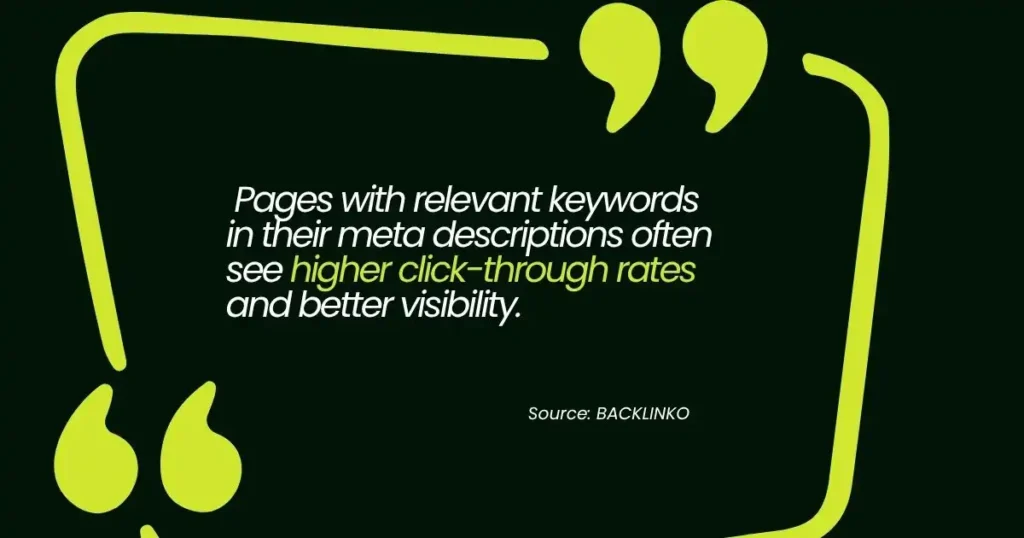
Pages with relevant keywords in their meta descriptions often see higher click-through rates and better visibility.
To improve your meta description, follow these tips:
- Use Your Focus Keyword Naturally: Blend your keyword naturally into the sentence, avoiding keyword stuffing.
- Place Your Keyword Strategically: Include the focus keyword within the first 50-60 characters for maximum impact.
- Consider Synonyms and Related Terms: Use variations or related terms to help your description stand out, especially if your keyword is highly competitive.
Incorporating the right focus keyword in your meta description boosts both search engine visibility and user engagement. Implementing these tips will improve your chances of ranking higher and driving more targeted traffic.
4. Meta Descriptions Should Be Descriptive
A meta description offers the chance to capture attention and drive clicks in search results. It should clearly communicate the value of your page, making users eager to click. Including key details like product specs, brand, price, or benefits helps address what users are actively searching for.
For example, instead of just saying “SEO services,” try “Boost your website’s traffic with expert SEO services tailored for your business.”
Using targeted keywords that align with the page title and user query ensures the description stands out with bolded text in the snippet. Avoid keyword stuffing or repetitive phrases like “Best SEO services | Affordable SEO | Top SEO experts” and instead keep it concise, relevant, and consistent with your brand’s voice to make the description more appealing.
5. Meta Descriptions Should Be Unique
Meta descriptions should be unique for each page to provide value to users and improve your rankings. Repeating the same meta description across multiple pages is ineffective and can confuse users, diminishing the relevance of your content. Search engines are less likely to use duplicate or unhelpful meta descriptions in their snippets.
Maximizing the impact of your meta descriptions requires following key practices that enhance both search engine rankings and user engagement. Below, we’ve outlined practical tips with examples to help you create unique and effective meta descriptions for each page.
| Aspect | Example | Why It Matters |
| Unique Descriptions for Each Page | Meta description about “SEO tips for beginners.”Meta description about “Top SEO strategies for 2026.” | Custom descriptions for each page improve engagement and relevance to both users and search engines. |
| Avoid Duplicates or Low-Quality Descriptions | Example of a poor description: “SEO and marketing tips for everyone.” | Duplicate descriptions confuse users and reduce SEO value; low-quality ones can be ignored by search engines. |
| Generate Meta Descriptions Programmatically | Automatically include page title, SEO-focused keywords, or page content in meta descriptions. | Saves time and ensures all pages have relevant descriptions, reducing the need for manual input. |
| Better No Description Than a Poor One | “No meta description” (if the page doesn’t need one) | Missing descriptions are better than generic or irrelevant ones, as they won’t harm rankings. |
Don’t miss the opportunity to make every page count. Unique meta descriptions are key to improving your visibility and attracting more clicks.
6. Keep Your Meta Description Under 160 Characters
Search engines typically display only the first 160 characters of a meta description in search results. If your description exceeds this limit, it will be cut off, often leaving information missing. This can significantly hurt your CTR as users may not get the full picture of what your page offers.
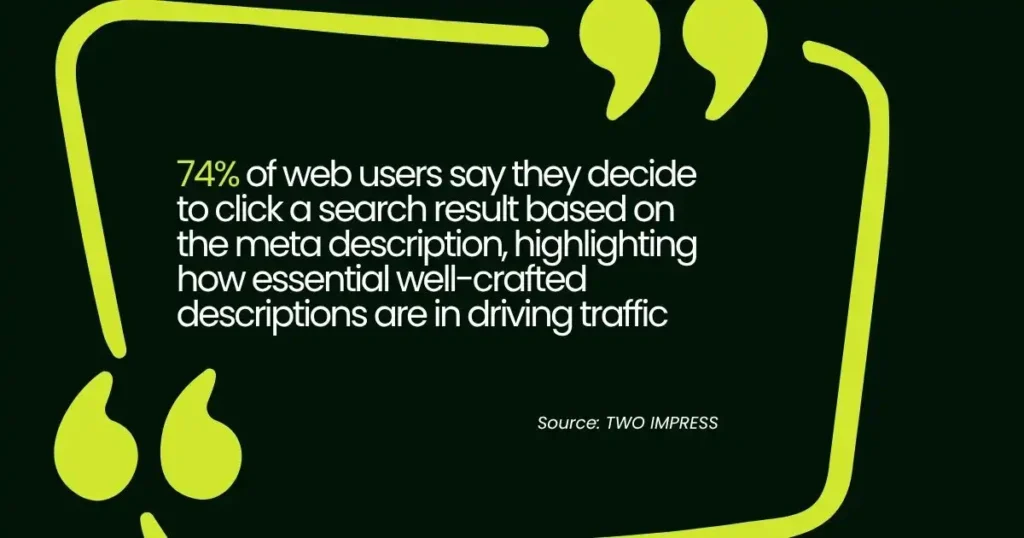
In fact,74% of web users say they decide to click a search result based on the meta description, highlighting how essential well-crafted descriptions are in driving traffic.
To ensure your meta description stays optimized:
- Use a SERP Snippet Tool: To ensure your meta description stays within the character limit, use a preview tool like the SERP Simulator, or for WordPress users, the built-in preview in the All in One SEO plugin.
- Be Concise: Eliminate unnecessary words or phrases that don’t add value to your description.
- Prioritize Key Information: Focus on the most essential details that clearly communicate what users will find on your page.
Keeping your meta descriptions short, clear, and within the 160-character limit helps improve visibility and boost your CTR. Don’t miss the chance to make every character count.
Why You Should Prioritize Meta Descriptions for SEO
Meta descriptions are a powerful tool that directly impacts your SEO performance. Though they don’t influence rankings, they drive traffic by compelling users to click. A well-crafted meta description serves as a mini-advertisement, summarizing its value and aligning with search intent.
Here’s why prioritizing them matters:
- Boost CTR: A compelling meta description attracts more clicks, increasing visibility.
- Align with Search Intent: Reflecting what users are looking for makes your content more relevant.
- Incorporate Keywords: Using target keywords makes your content appear more relevant in search results.
- Enhance User Experience: A well-written description sets clear expectations for users, improving engagement.
- Increase Traffic: More clicks lead to higher traffic and better site performance.
Example:
For a page about local SEO services, a well-crafted meta description like “Need local SEO services to grow your business? Improve your local rankings, attract more nearby customers, and increase enquiries with proven SEO strategies.“ is effective because it directly matches the user’s intent, includes relevant keywords such as “local SEO services,” “local rankings,” and “nearby customers,” and clearly highlights the benefit of the service. This makes the meta description more compelling, increasing the likelihood of clicks and improving visibility in search results.
Prioritizing meta descriptions increases click-through rates and enhances user experience, driving engagement and overall site success.
Take Your SEO To The Next Level With Meta Description Tips
Mastering how to write a good meta description is an important part of on-page SEO. A well-crafted meta description can improve click-through rates, attract more visitors from search results, and increase engagement. Poorly optimized descriptions can reduce visibility and send potential customers to competing websites. Writing clear, relevant, and keyword-focused meta descriptions for every page helps strengthen your on-page SEO and improve organic performance.
Your meta descriptions are the first impression users have of your content. Failing to optimize them means losing valuable traffic to your competitors. At Sam SEO Philippines, we specialize in creating compelling, click-worthy meta descriptions that align with your SEO goals. Let us help you boost your rankings and drive more targeted traffic. Contact us today to optimize your SEO and stand out in search results.
FAQs About Meta Description
How Do Meta Descriptions Impact My Website’s Mobile Performance?
Meta descriptions have a significant impact on mobile search performance by influencing how your page appears in search results. A compelling description encourages users to click, especially on mobile devices where screen space is limited. Optimized descriptions help increase click-through rates, improving your site’s mobile visibility.
Can I Use The Same Meta Description Across Multiple Pages?
It’s not recommended to use the same meta description on multiple pages. Unique descriptions help search engines and users understand the distinct content of each page. This ensures better relevance, higher CTR, and improved SEO.
What Happens If My Meta Description Is Too Long?
If your meta description exceeds 160 characters, search engines may truncate it. This can lead to missing or incomplete information in the snippet, lowering the chance of attracting clicks. Keeping your description concise ensures it’s fully visible in search results.
How Often Should I Update My Meta Descriptions?
Meta descriptions should be updated whenever there’s a change in content or promotions. Regular updates ensure they stay relevant and accurately reflect your page’s current offerings. This helps maintain high CTR and user engagement.