
A five-star service record is worthless the moment it stays invisible to the people searching for it. Plenty of business owners deliver excellent work and still watch other businesses with a thinner track record outrank them, mainly because those businesses have more reviews attached to their Google Business Profile.
According to WordStream, 88% of consumers trust online reviews as much as personal recommendations from friends or family, which puts review volume ahead of almost every other trust signal a small business can control. So how do you get more Google reviews without breaking Google’s rules or wasting time on the wrong moves?
Why do Google Reviews Matter for Local SEO?
Google reviews matter for local SEO because they directly influence prominence, one of Google’s three local ranking factors, while also increasing click-through rates and consumer trust before a customer ever visits the website. Strong online reviews SEO performance starts here, since prominence is one of the few ranking signals a business can actively shape.
Google confirms that review count and rating quality help determine local ranking, alongside relevance and distance (Google Business Profile Help). A steady stream of new reviews signals an active, trustworthy business rather than a stagnant listing, and responding to feedback shows both customers and Google that the profile is being actively managed.
Higher ratings and review counts also increase the likelihood a searcher clicks a listing over another one, since online reviews carry real weight in how people decide who to trust and buy from. That combination of ranking influence and buyer trust is why Local SEO Services treat review growth as one of the most controllable signals a business owns.
How to Get More Google Reviews: A Step-by-Step Process
Getting more Google reviews is not about luck or one clever trick. It comes down to following a clear process, in order, and repeating it consistently until it becomes part of how the business runs.
1. Claim and Fully Optimize the Google Business Profile
Accurate name, address, phone number, hours, categories, and photos give Google enough context to trust the listing and give customers enough confidence to leave a review. An incomplete profile is a leak in the system before a single review request ever goes out, in much the same way weak Technical SEO undermines an otherwise well-written page, since customers hesitate to trust a listing that looks abandoned or unfinished.
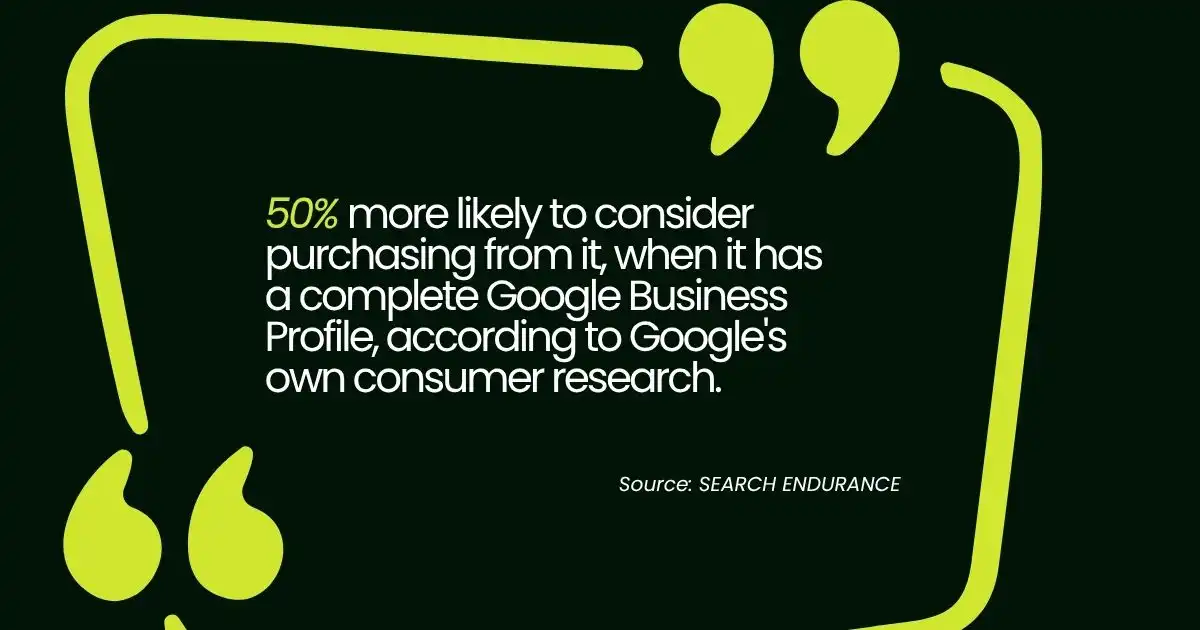
Consumers are 2.7 times more likely to consider a business reputable, and 50% more likely to consider purchasing from it, when it has a complete Google Business Profile, according to Google’s own consumer research. That trust gap is exactly why review requests sent from a half-filled profile tend to underperform even when the message itself is good.
2. Generate a Direct Review Link or QR Code
Inside the Business Profile, the “Ask for reviews” option produces a link that takes a customer straight to the review box, removing the extra steps that cause people to abandon the process.
From an SEO standpoint, this step is where review requests actually turn into ranking signals. A local HVAC company that embeds its direct review link in every service confirmation email, instead of asking customers to search for the business on Google Maps themselves, typically sees its review count climb every month rather than in random bursts. Google’s local algorithm reads that steady, embedded pattern as an active and prominent listing, which is one of the simplest review generation tactics an SEO strategy can put to work directly.
3. Ask at the Moment of Peak Satisfaction
The best time to request a review is right after a completed job, a delivery, or a positive support interaction, while the experience is still fresh. Waiting even a few days lets the memory fade and the motivation disappears with it.
The strongest moments to ask include:
- Immediately after a technician or service provider finishes the job on-site
- Right after a customer confirms a delivery arrived complete and undamaged
- At the close of a support call or chat that resolved the customer’s issue
- Following a five-star mention in an email, text, or verbal comment from the customer
None of these moments matter if the request depends on remembering to send it manually. The next step is choosing the channel that gets that request in front of the customer while the moment is still working in the business’s favor.
4. Match the Request to the Customer’s Preferred Channel
Post-purchase email, SMS or text follow-up, WhatsApp, a printed QR code at checkout, or a simple website widget all work, but the channel needs to fit how that customer already communicates with the business. A service business that only emails customers who mostly respond over text is adding friction it does not need to add.
The channel matters less than consistency. Businesses that pick one or two channels and use them for every customer, every time, build a review pipeline that keeps producing results, while businesses that switch tactics every few weeks rarely build enough momentum to see a real pattern emerge.
5. Use a Real Script Instead of a Vague Ask
A short, specific line such as “A Google review would help us a lot. Just search for us on Google Maps and tap the review button” performs better than a generic request. The wording matters because customers respond to specificity, not to being asked in general terms.
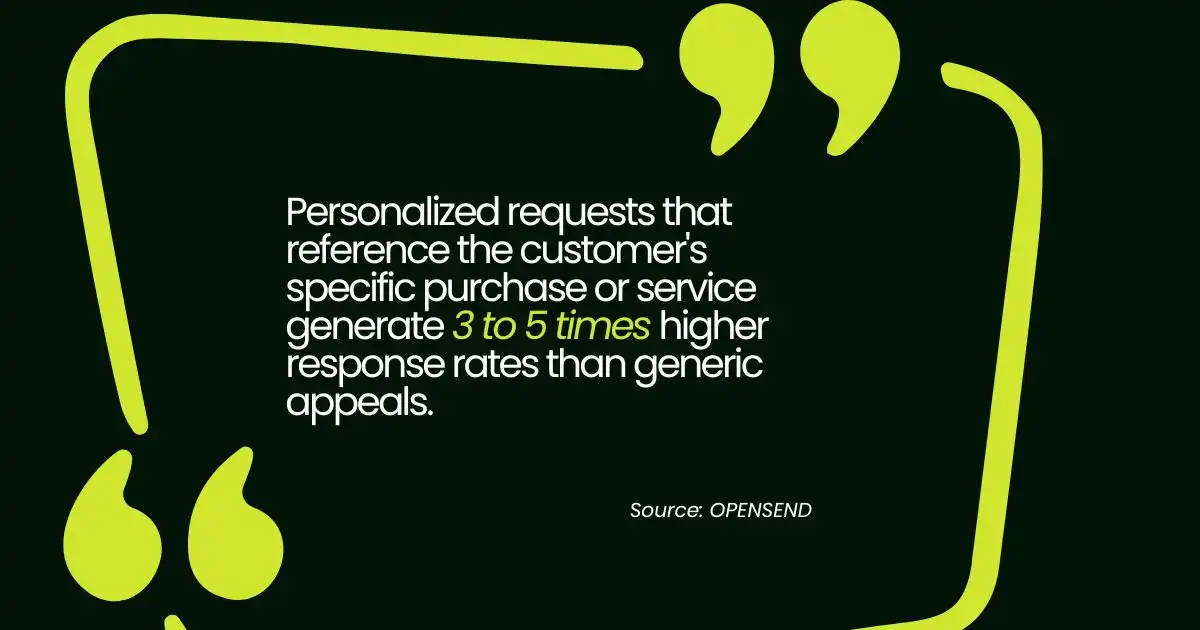
Personalized requests that reference the customer’s specific purchase or service generate 3 to 5 times higher response rates than generic appeals, according to Opensend’s review response research. A message that names the service performed or the product delivered will consistently outperform a copy-pasted line sent to every customer the same way.
6. Respond to Every Positive and Negative Review
A prompt, professional reply signals to both the customer and Google that the business is active and pays attention to feedback. Responses do not need to be long, but they do need to be specific and calm, especially on critical reviews. This is where customer review management becomes part of the ongoing routine rather than a one-off task.
The right response depends entirely on the type of review it is answering:
| Review Type | Response Approach | What to Avoid |
| Positive review | Thank the customer by name and mention the specific service or product | A copy-pasted “Thank you for your review!” with no detail |
| Neutral review | Acknowledge the feedback and ask how the experience could improve | Ignoring it because it is not clearly negative |
| Negative review | Apologize, stay factual, and offer to resolve the issue offline | Arguing publicly or disputing the customer’s account |
| Fake or policy-violating review | Flag it through Google’s reporting tool before responding | Accusing the reviewer publicly of dishonesty |
Treating every review type with the same generic reply wastes an opportunity Google is already tracking. A business that responds thoughtfully to each category builds a visible pattern of active management, which carries more weight with both customers and Google’s ranking systems than the star rating alone.
7. Ask Every Customer Not Only the Happy Ones
Filtering out dissatisfied customers before they reach the review link is a form of review gating, and it puts the profile at risk. Google’s policies require that every customer have equal access to the review request, regardless of how the interaction went.
A simple way to keep this practice consistent:
- Build the review request into the standard post-service or post-purchase workflow, not into a manual, case-by-case decision.
- Send the same request to every customer who completes that workflow, without checking satisfaction first.
- Handle any negative feedback that comes in through the public review, not by diverting the customer somewhere else beforehand.
For example, a dental practice that sends the same review request text to every patient after a visit, rather than reserving it for patients who seemed happy at checkout, keeps its review profile authentic and avoids the kind of selective pattern Google’s fraud detection systems are built to catch.
8. Keep a Steady Pace of New Reviews
Google is more likely to trust a business that earns reviews consistently over time than one that shows a long gap followed by a sudden spike. Review velocity, not just review count, is part of how Google reads whether a business is genuinely active.
Picture two coffee shops on the same street. One goes eight months without a new review, then suddenly gets 40 reviews in a single weekend because the owner finally remembered to ask. The other picks up two or three new reviews almost every week, month after month, without ever making a big push. Even if both end up with a similar total, the second shop’s pattern looks like a real, ongoing business, while the first shop’s sudden spike is exactly the kind of pattern that draws extra scrutiny from Google’s review integrity systems.
Which Businesses See the Biggest Impact From Google Reviews
Review growth does not help every business the same way, but almost every business can get more Google reviews with the right process in place. Some industries convert reviews into rankings and bookings almost immediately, while others see the benefit build more slowly over time. The clearest patterns show up across four types of businesses.
- Local, appointment-based businesses. Clinics, contractors, salons, and law firms see the fastest ranking movement once review volume grows, since these categories rely on local search and word of mouth over brand recognition.
- Multi-location businesses. Consistency across dozens of profiles is the real challenge, not review generation. Schweiger Dermatology Group automated requests across 90+ locations, tripling reviews while holding a 4.5-star average.
- Single-location, in-person businesses. These businesses see strong results from simple setups. Viewpoint Fitness grew its review count with just a printed QR code at checkout, removing the friction that stops feedback.
- Content-driven businesses. Businesses producing service pages or blog posts can extend the impact by folding review themes into content. Pairing that with Keyword Research Services reinforces the online reviews SEO signals Google rewards.
Ready to Turn Happy Customers Into Five-Star Rankings?
More Google reviews rarely come from luck. They come from a complete profile, a direct link customers can use in seconds, a request sent at the right moment, and a steady pace kept up month after month. Businesses that build this into a repeatable process, rather than a one-time push, end up with the review volume and ranking movement that Google rewards and customers trust. Getting there consistently is what separates a real Google review strategy from a handful of scattered requests.
Sam SEO Philippines helps local and multi-location businesses get more Google reviews and build the local SEO structure that turns those reviews into rankings. Contact us to build a strategy that keeps working long after the first request goes out.
Frequently Asked Questions About Getting More Google Reviews
How long does it take to see results from Google review management services?
Early movement usually shows up within four to six weeks, once request workflows are active and reviews start landing consistently, giving businesses a fast, measurable way to get more Google reviews. Full ranking impact builds over three to six months, since Google reads sustained activity more favorably than a fast spike.
Businesses starting from a thin review history typically see faster relative gains than established profiles with hundreds of reviews already in place. For a realistic timeline based on your current review count and market competition, our onboarding audit maps out exactly what to expect before any work begins.
What happens if my business gets a fake or malicious review?
Sam SEO Philippines monitors flagged and suspicious reviews as part of ongoing account management, reporting policy violations through Google’s official channels rather than leaving clients to handle disputes alone. Response drafting for negative and fake reviews is included, written to stay factual and calm without escalating the situation publicly.
Removal isn’t guaranteed since Google makes the final call, but a properly documented report has a meaningfully higher success rate than an unreported complaint. For an account that actively defends your rating instead of reacting after damage is done, our review management service includes this monitoring by default.
Do I need a contract to start Google review management services?
Most engagements run month to month, since review growth depends on consistent execution rather than a fixed project timeline. Businesses can pause or adjust scope as review volume or location count changes without being locked into a long-term commitment.
This structure works better than a rigid contract for seasonal businesses or those testing results before scaling up. For a setup that flexes with your business instead of forcing a one-size commitment, reach out and Sam SEO Philippines can walk through the available terms.
Can Google review management services work alongside my existing marketing team?
Review request workflows and response management integrate into whatever tools a business already uses, whether that’s an email platform, a CRM, or a point-of-sale system at checkout. Existing marketing or front-desk staff don’t need to change how they work, since the system runs in the background rather than replacing current processes.
Coordination happens through a shared reporting dashboard, so internal teams stay informed without needing to manage the day-to-day review requests themselves. For an integration plan that fits your current setup, our onboarding process starts by mapping what tools and workflows are already in place.