
If you’re not focusing on page rank authority, you’re missing out on valuable rankings while competitors pull ahead. Page rank authority, the combined strength of your page’s backlink profile and content signals, is what Google uses to decide which results deserve the top spots.
A PA score of 51 or higher is considered strong, but most websites fail to reach this level by overlooking PA. Too often, SEO strategies focus on keywords and backlinks, but page authority score can be the factor that pushes your site ahead in search rankings.
So, what is a good Page Authority score? Optimizing your PA could be the missing piece to skyrocketing your website’s visibility. What if improving your PA is the game-changer your SEO strategy needs? Your competitors might already be ahead, so it’s time to act before you fall further behind.
What Is A Good Page Authority Score
Knowing your page authority score starts with understanding the scale. Before you can determine page authority benchmarks, it helps to know the scale. A good PA score typically ranges from 30 to 70, and once you can determine page authority for your pages, you can set realistic improvement targets. Page rank authority is a relative metric; what counts as strong depends entirely on your competition.
A page rank authority score of 30 may dominate a local niche but fall flat in a highly competitive national market. For instance, a PA of 30 is excellent in a low-competition niche but may be weaker in a high-competition industry.
PA follows a logarithmic scale, meaning it’s easier to improve from 10 to 20 than from 60 to 70. To improve PA, focus on gaining quality backlinks through consistent link building, using internal linking, and creating high-quality content. New pages typically start with a PA of 0, and improving your score requires consistent effort.
How to Improve Page Authority
Improving page authority is a strategic, ongoing effort. The first step is to determine page authority for your key pages so you have a baseline to measure progress against. Top PA scores come from quality content, effective link building, and consistent optimization. Here’s what truly drives results.
Age And Trust
Search engines build trust over time, not instantly and your page authority score reflects that. Pages that have been live for years tend to carry a stronger page authority score because they’ve had more time to accumulate backlinks and engagement signals.
Older pages tend to rank better because they have had more time to earn backlinks, attract traffic, and generate consistent engagement, all of which signal reliability. Over time, content improves through updates and refinements, increasing relevance and overall quality
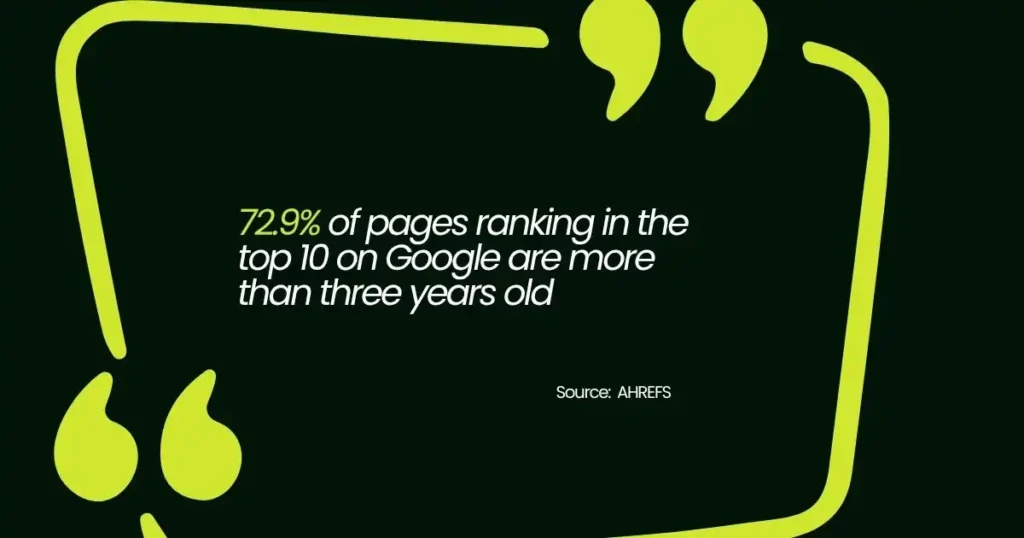
A large-scale Ahrefs study found that 72.9% of pages in Google’s top 10 are over three years old, a clear indicator that page rank authority compounds with time. Pages that have steadily earned backlinks and engagement over the years tend to hold the strongest page rank authority signals.
For your strategy, avoid deleting or redirecting older pages unless it is necessary, since they carry accumulated authority. Preserve your URLs and refresh your content regularly to maintain relevance while retaining existing link equity.
Popularity
In calculating your page authority score, popularity is driven primarily by backlinks, especially the number and quality of external domains linking to your page. The more authoritative those links are, the higher your page authority score climbs.
The concept is rooted in the original PageRank model used by Google, where a page’s value is determined by who links to it. A single backlink from a high-authority site carries significantly more weight than hundreds of low-quality links, making quality far more important than volume.
Backlinks remain one of the strongest ranking signals. Studies consistently show that pages with more referring domains tend to rank higher, reinforcing the direct relationship between link authority and search visibility.
To determine page authority improvements needed at the page level, focus on the following actions:
- Earn editorial backlinks by publishing original, data-driven, or highly useful content
- Guest post on authoritative sites and link to relevant pages
- Use internal linking to distribute authority across your site
- Run a link gap analysis using tools like Ahrefs, Moz, or Semrush. These same tools let you determine page authority for any URL, including your competitors’
- Create linkable assets such as guides, statistics, and infographics
Popularity grows as your content earns links from credible sources. The more high-quality sites that reference your page, the stronger its authority and ranking potential become.
Freshness Of The Last Update
Content freshness directly influences page rank authority because search engines reward pages that stay accurate and relevant. Regularly updated pages signal to Google that their page rank authority is backed by current, trustworthy information.
Pages that remain unchanged over time often signal outdated information, while regularly updated content demonstrates accuracy, completeness, and alignment with current user intent. Search engines prioritize content that evolves.
Freshness involves improving your content by making it more accurate, relevant, and useful over time.
To keep content fresh and competitive:
- Audit your top pages regularly to identify outdated statistics, broken links, and missing content
- Update metadata alongside content to reflect current relevance and improve click-through rates
- Expand content based on evolving search intent by addressing new and relevant user questions
- Re-promote updated content through internal linking, email, and social channels to encourage re-crawling
- Use structured data signals like dateModified to clearly indicate updates to search engines
Freshness becomes critical when rankings decline, new information emerges, or your industry shifts.

For example, updating a blog with the latest data and insights can help regain lost rankings and improve visibility.
Pages that are left untouched gradually lose ground to competitors who continuously improve their content. Content is not a one-time effort. It is a continuous process that strengthens relevance, protects rankings, and builds long-term authority.
What Constitutes A Good Domain Authority Score?
Understanding what qualifies as a good Domain Authority score helps benchmark your site’s SEO performance and competitive position. Each range reflects a stage of growth, guiding your strategy for improving visibility and rankings.
0–10 (Below Average – Starting Point)
At an early stage, a website is new or has very limited authority signals. Most domains in this range have little to no backlink profile, making it difficult to rank outside highly specific, low-competition queries.
Here’s what the range typically looks like in practice:
- New websites with little to no backlink profile
- Minimal authority and highly limited ranking potential
- Can rank only for very niche, low-competition queries
- Focus: build foundational content and earn first-quality backlinks
- High growth potential since every improvement has an impact
Consistency matters most, as early SEO efforts compound and build long-term authority.
11–20 (Average – Early Traction)
The range reflects early traction, where a site has started building a base level of authority. Websites begin ranking for localized searches and niche blog queries, though competition remains a challenge.
In practical terms, you can expect:
- Growing backlink profile with initial authority signals
- Ability to rank for localized and niche keywords
- Continued difficulty with competitive search queries
- Authority remains sensitive to backlink changes
- Focus: consistent publishing, directory listings, and niche backlinks
Steady execution often leads to noticeable gains in rankings and organic traffic.
21–30 (Good – Growth Stage)
A Domain Authority score in this range signals a solid SEO foundation. Small businesses and content-driven websites often sit here, with the ability to rank for long-tail and some moderately competitive keywords.
At that level, performance generally includes:
- Solid backlink profile and improving domain trust
- Ability to rank for long-tail and low-to-medium competition keywords
- Strong opportunity for local SEO and blog content visibility
- Difficulty competing for national-level keywords
- Focus: scale content and acquire higher-authority backlinks
A pivotal growth stage where a strong strategy determines future authority gains.
31–40 (Very Good – Established Presence)
At this level, a domain has built credibility in your search engines. Based on industry benchmarks, websites here can compete for moderately competitive and some national-level keywords.
Websites in the range often show:
- Credible backlinks from authoritative and relevant websites
- Ability to compete for moderately competitive and some national keywords
- Consistent ranking ability across multiple pages
- Slower growth requires a stronger strategy
- Focus: content depth, differentiation, and authority link building
Progress beyond this point requires more deliberate SEO investment and higher-quality links.
41–50 (Excellent – Competitive Authority)
The range represents strong domain authority. A site becomes a serious competitor, often ranking across a wide set of keywords and benefiting from consistent, high-quality backlinks.
At this stage, you will typically see:
- Strong, consistent backlinks from high-authority sources
- Rankings across a wide range of keywords, often nationally
- Pages attract backlinks naturally due to established trust
- Recognition as a reliable and authoritative source
- Focus: scale content, optimize performance, and remove technical barriers
Scaling SEO efforts at this level can significantly increase visibility, traffic, and conversions.
51+ (Superb – Elite Authority)
Websites with a Domain Authority of 51+ are considered industry leaders. Domains at this level have a strong competitive advantage and can rank for highly competitive, high-volume keywords with greater ease.
In real-world performance, it means:
- Highly authoritative domain dominating its niche
- Strong ranking advantage even before optimization
- Ability to compete for highly competitive, high-volume keywords
- Typically, national or industry-leading brands
- Focus: protect rankings, expand keyword coverage, and maintain authority
Maintaining authority at this level requires ongoing investment and delivers long-term organic dominance.
Page rank authority is always relative to your competitors, not a fixed benchmark. The goal is to build page rank authority that keeps you ahead of whoever is ranking above you for your target keywords.
The goal is steady growth aligned with your niche, content strategy, and backlink profile, supported by consistent optimization across content, links, and technical SEO.
Boost Your Authority Score Today
Page Authority and Domain Authority growth is built through consistent, strategic SEO, not quick wins. If you’re not sure how to determine page authority for your site or where to start, contact Sam SEO Philippines for a free audit.
Strong performance comes from a combination of high-quality content, authoritative backlinks, and continuous on-page SEO optimization. Rather than focusing on a single score, the goal is to steadily improve your site’s authority, relevance, and competitiveness within your niche.
If you want to accelerate your results and turn your SEO efforts into real growth, contact us at Sam SEO Philippines, and let’s build a strategy that improves authority, boosts rankings, and drives consistent organic traffic.
FAQs About Page Authority and Domain Authority
How does Page Authority differ from Google rankings?
Page Authority (PA), developed by Moz, is a third-party metric that predicts how well a page might rank. Google does not use PA directly in its algorithm. Instead, it evaluates hundreds of ranking factors such as content relevance, backlinks, and user experience. PA should be used as a comparative benchmark rather than a direct ranking signal.
Can Domain Authority improve Google ranking results?
Domain Authority does not directly influence Google rankings, but page rank authority, earned through quality content and strong backlinks, does correlate strongly with better positions. Focusing on page rank authority at the page level is the more actionable SEO priority.
It is a score designed to estimate the strength of a website’s backlink profile. Higher DA often correlates with better rankings, but it is not a guarantee. Actual rankings depend on content quality, search intent, and competition.
How long does it take to improve Page Authority score?
Improving your page authority score typically takes several weeks to months, depending on your SEO efforts. The timeline varies based on how quickly you earn quality backlinks and how consistently you update content to keep your page authority score growing. The timeline is influenced by how quickly you gain quality backlinks and update your content. It also depends on how often SEO tools recrawl and update their data. Consistent optimization and link-building are required to see steady improvement.
Should you focus on Page Authority or Domain Authority?
Page Authority focuses on the ranking strength of individual pages, while Domain Authority reflects the overall strength of a website. Both metrics are useful for evaluating SEO performance from different perspectives. Strong domains can help pages rank faster, while strong pages contribute to overall authority growth. A balanced strategy should aim to improve both over time.