
Keyword research is the foundation of every successful SEO campaign. Get it wrong, and you write content nobody searches for. Get it right, and you build a site that pulls in traffic month after month. As an SEO keyword tool, Semrush helps you uncover the terms people actually type into Google, not just the ones you assume they use. You’ll learn how to pull keyword ideas, read the metrics that matter, filter out weak opportunities, study your competitors, and group everything into topic clusters. No advanced SEO background is needed. If you can use a search bar, you can follow this Semrush keyword research tutorial from start to finish.
How Does Semrush Keyword Research Work?
Keyword research is the process of identifying and evaluating the words and phrases people type into search engines. It helps you understand what your target audience wants so you can create content that matches real search demand instead of relying on assumptions.
Search engines rank pages based on how well they answer a user’s query, which is exactly why this Semrush keyword research tutorial starts with understanding search intent. If you skip keyword research, you risk publishing content that no one is searching for or targeting terms that are too competitive to rank.
Following a Semrush keyword research tutorial gives you access to search volume, keyword difficulty, search intent, and competitor insights, allowing you to make data-driven decisions at every stage of your SEO strategy.
| Semrush Tool | Primary Function | How It Helps with Keyword Research |
| Keyword Magic Tool | Generate keyword ideas | Expands a seed keyword into thousands of related keyword suggestions, including long-tail and question-based searches. |
| Keyword Overview | Validate individual keywords | Provides key metrics such as search volume, keyword difficulty, search intent, CPC, and SERP features to help evaluate a keyword’s potential. |
| Organic Research | Find competitor keywords | Reveals the keywords your competitors rank for, along with the pages driving their organic traffic. |
| Keyword Gap | Compare your site against competitors | Identifies keywords your competitors rank for that your website is missing, helping you uncover new content opportunities. |
| Position Tracking | Monitor keyword rankings | Tracks your keyword rankings over time so you can measure SEO performance and monitor progress. |
Each of these Semrush tools plays a unique role in the keyword research process, from generating new keyword ideas to validating opportunities and tracking your rankings over time. Understanding what each tool does will help you build a more efficient workflow and make informed SEO decisions.
8 Ways How to Perform Keyword Research Using Semrush
1. Enter a Seed Keyword in Keyword Magic Tool
The Keyword Magic Tool is one of the most useful features in this SEO keyword tool for generating keyword ideas from a single search term. Start by opening the Keyword Magic Tool from the Semrush sidebar under SEO > Keyword Research.
Enter a broad seed keyword that describes your topic using one or two words, then select your target country database before running the search. Choosing the right seed keyword helps Semrush return a larger and more relevant list of keyword opportunities, which is the real starting point of any Semrush keyword research tutorial.
- Use a broad keyword instead of a highly specific phrase.
- Choose terms your target audience is likely to type into Google.
- Avoid brand names unless you’re researching branded keywords.
- Test several keyword variations to uncover a wider range of opportunities.
After running your search, Semrush will generate thousands of related keywords along with valuable SEO metrics, including search volume, keyword difficulty, search intent, CPC, and SERP features. These insights help you narrow your options and identify the keywords with the greatest potential for your content strategy.
2. Understand the Keyword Metrics
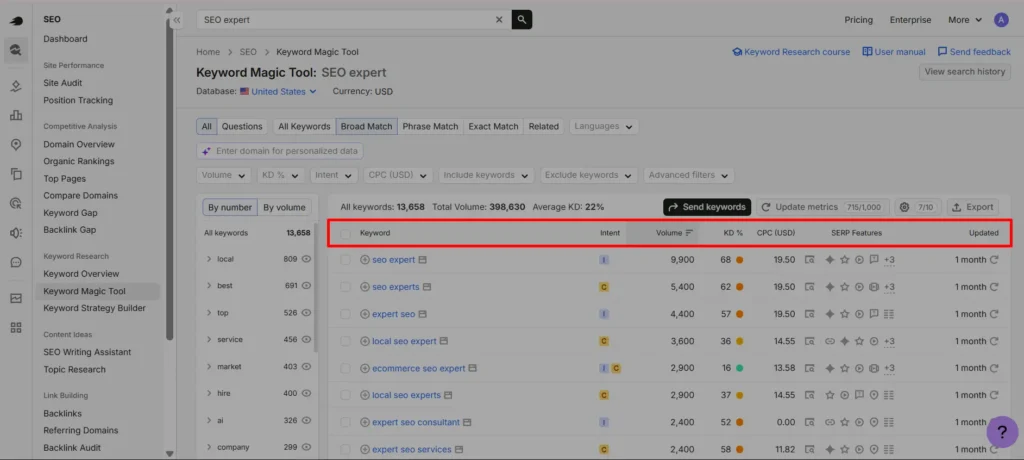
Once Semrush generates your keyword ideas, every column in the results table provides valuable insights that help you evaluate a keyword’s potential. Learning how to interpret these metrics will help you prioritize keywords that align with your SEO goals.
| Keyword Metric | What It Means | Why It Matters |
| Search Volume | The average number of monthly searches for a keyword in your selected country. | Indicates the level of search demand. Higher search volume can mean greater traffic potential, though it often comes with more competition. |
| Keyword Difficulty (KD) | A score from 0 to 100 that estimates how difficult it is to rank in Google’s top search results. | Lower scores are generally easier to rank for, making them ideal for newer websites or low-authority domains. |
| Search Intent | Shows the purpose behind a user’s search. Semrush classifies keywords as Informational, Commercial, Transactional, or Navigational. | Matching your content to the correct search intent increases your chances of ranking and satisfying user expectations. |
| Cost Per Click (CPC) | The average amount advertisers pay for a click on a keyword in Google Ads. | A higher CPC often indicates stronger commercial value and greater business potential. |
| Competitive Density | Measures how competitive a keyword is among advertisers in paid search. | High competitive density often signals keywords with strong commercial intent and high conversion potential. |
| SERP Features | Displays special Google search features associated with a keyword, such as Featured Snippets, People Also Ask, AI Overviews, Local Packs, Images, or Videos. | Understanding SERP features helps you optimize content for additional visibility beyond traditional organic listings. |
By reviewing these metrics together instead of relying on a single number, you can identify keywords that offer the right balance of search demand, ranking potential, and relevance to your audience.
3. Filter Keywords to Find Better Opportunities
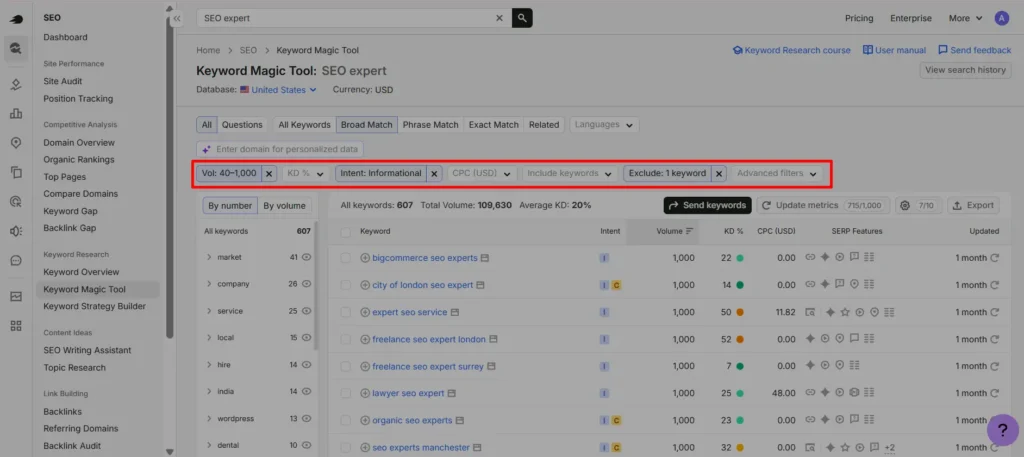
After generating a list of keyword ideas, this Semrush keyword research tutorial shows how filtering helps you focus on terms that are relevant, achievable, and aligned with your SEO goals.
- Use Keyword Difficulty filters to set a maximum KD score, such as 40 to 50, and remove keywords that are too competitive for your website.
- Filter search volume by setting a minimum monthly search threshold, so you focus on keywords with meaningful search demand.
- Include and exclude keywords to refine your results. Add relevant words to the Include filter and remove unrelated terms with the Exclude filter.
- Find question keywords by switching to the Questions tab. These queries are ideal for blog headings, FAQ sections, and featured snippet opportunities.
- Find long-tail keywords by filtering for search phrases with four or more words. These keywords often have lower competition, clearer search intent, and higher conversion potential.
Applying these filters helps you transform a large keyword list into a focused set of opportunities that are easier to target and more likely to deliver meaningful SEO results.
4. Analyze Individual Keywords with Keyword Overview
After narrowing down your keyword list, this stage of the Semrush keyword research tutorial uses the Keyword Overview tool to validate each keyword before creating content. This helps you confirm that a keyword is worth targeting and gives you a clearer understanding of the competition.
| Analysis Step | What to Check | Why It Matters |
| Review Trend Data | Check if the keyword’s search volume is increasing, decreasing, or follows seasonal trends. | Prioritize keywords with consistent or growing search demand to maximize long-term traffic potential. |
| Examine Search Intent | Verify that the keyword’s intent matches the type of content you plan to create, such as an informational blog post or a product page. | Aligning your content with search intent improves user satisfaction and increases your chances of ranking. |
| Check SERP Features | Review which Google SERP features appear for the keyword, such as AI Overviews, Featured Snippets, People Also Ask, Images, Videos, or Local Packs. | Understanding the search results helps you optimize your content for additional visibility beyond standard organic listings. |
| Analyze Ranking Pages | Study the top-ranking pages to understand their content format, length, headings, and overall structure. | Analyzing competitors helps you identify content gaps and create a more comprehensive page that can compete effectively in search results. |
Reviewing these factors before publishing ensures you’re targeting keywords with strong ranking potential while creating content that meets user expectations and stands out from competing pages.
5. Find Competitor Keywords
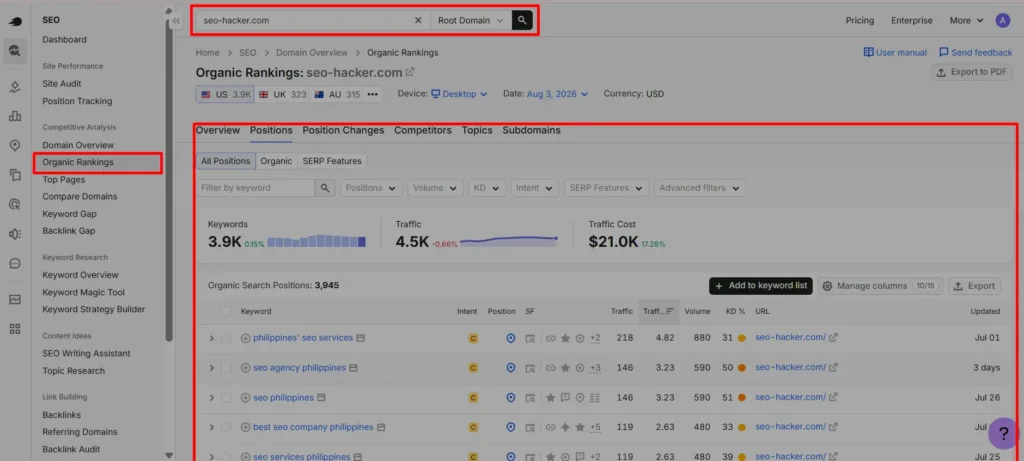
One of the fastest ways to uncover valuable keyword opportunities in this Semrush keyword research tutorial is by analyzing the keywords your competitors already rank for. The Organic Research tool in Semrush reveals which search terms drive traffic to competing websites, helping you identify gaps and refine your own SEO strategy.
- Enter a competitor’s domain by opening Organic Rankings and pasting a competitor’s URL into the search bar.
- View top-performing keywords by sorting results by traffic or ranking position to identify the keywords driving the most organic visibility.
- Find pages driving the most traffic by selecting the Pages tab to see which URLs attract the highest number of organic visits.
- Export useful keywords and compare them with your own website to identify keyword gaps and new content opportunities you haven’t targeted yet.
By studying competitor keywords, you can discover proven topics, prioritize high-value search terms, and create content that competes more effectively in search results.
6. Use Keyword Gap to Find Missing Opportunities
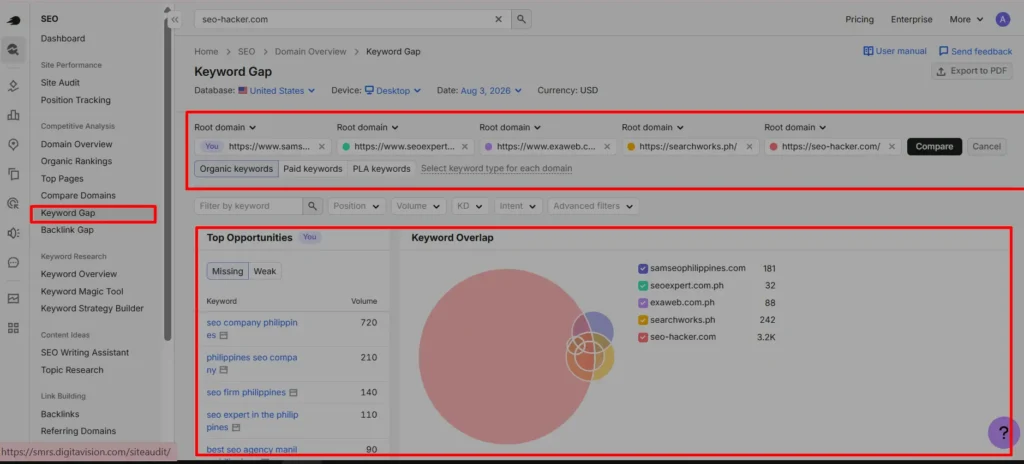
The Keyword Gap tool, a core part of any Semrush keyword research tutorial, helps you uncover valuable keywords your competitors rank for, but your website doesn’t. Comparing your site against competing domains allows you to identify content gaps, expand your keyword strategy, and prioritize opportunities with strong ranking potential.
- Compare multiple competitors by entering your domain along with up to four competing websites to view keyword overlaps and gaps in a single report.
- Identify missing keywords by filtering for search terms that your competitors rank for, but your website does not, then sort the results by search volume or keyword difficulty.
- Prioritize easy wins by focusing on keywords where competitors rank on the second or third page of Google, as these often present achievable opportunities with less competition.
Regularly reviewing your Keyword Gap report helps you discover new content ideas, strengthen your topical authority, and capture organic traffic your competitors are already earning.
7. Group Keywords into Topic Clusters
Instead of creating a separate page for every keyword, this Semrush keyword research tutorial recommends organizing related keywords into topic clusters. This approach helps search engines understand your site’s expertise on a subject while improving internal linking and creating a better user experience. Each cluster should focus on a primary topic supported by related keywords and complementary content.
| Cluster Element | Purpose |
| Primary Keyword | The main keyword that defines the page’s primary topic and serves as the primary SEO focus. |
| Secondary Keywords | Closely related keywords and variations that are naturally incorporated throughout the content to improve topical relevance. |
| Supporting Questions | Common questions and subtopics that address related search queries and increase the page’s topical depth. |
| Internal Linking | Links connecting supporting pages to a central pillar page, helping search engines understand content relationships and distribute authority across your website. |
Building topic clusters instead of targeting isolated keywords strengthens your site’s topical authority, improves content organization, and increases your chances of ranking for a wider range of related search queries.
8. Choose the Best Keywords for Your Website
After researching and analyzing your keyword opportunities, the final step is deciding which keywords to target. Focus on keywords that align with your content strategy, match your audience’s needs, and offer realistic ranking potential.
- Match search intent by choosing keywords that align with the type of page you’re creating, such as a blog post, service page, product page, or landing page.
- Balance search volume and competition by prioritizing keywords with moderate search volume and lower competition, as they often provide better ranking opportunities than highly competitive terms.
- Focus on business relevance by targeting keywords that relate directly to your products, services, or areas of expertise. High search volume has little value if the keyword doesn’t attract your ideal audience.
- Consider topical authority by selecting keywords that strengthen your existing content clusters instead of creating isolated pages with little connection to the rest of your website.
Choosing keywords strategically, as outlined in this Semrush keyword research tutorial, helps you build a stronger SEO foundation, create more relevant content, and improve your chances of attracting qualified organic traffic over time.
Why Hire an SEO Professional for Keyword Research?
Semrush is a powerful platform, but having access to the tool doesn’t automatically lead to better SEO results. Successful keyword research requires understanding search intent, evaluating keyword difficulty, analyzing competitors, and building a content strategy around topics that support your business goals.
An experienced SEO professional knows how to apply the steps in this Semrush keyword research tutorial and turn the data into an actionable strategy. Instead of targeting keywords based on search volume alone, they identify opportunities that align with your industry, audience, and website authority. They also create topic clusters, uncover content gaps, and prioritize keywords that have the greatest potential to drive qualified organic traffic.
Improve Your Website Performance with Professional SEO
Strong Core Web Vitals help create a faster, more responsive website while supporting better search visibility. Improving these metrics requires identifying performance issues and applying the right technical SEO solutions to enhance loading speed, responsiveness, and visual stability.
At Sam SEO Philippines, we specialize in Core Web Vitals optimization and Technical SEO. Our SEO experts identify performance bottlenecks, implement proven optimizations, and help improve your website’s speed, user experience, and organic performance.
Ready to improve your website’s performance? Contact us today for a Core Web Vitals audit and let our SEO experts help you build a faster, higher-performing website.
Frequently Asked Questions
1. Why should I hire an SEO expert for keyword research?
An SEO expert identifies the keywords that are most likely to generate qualified traffic and conversions. They analyze search intent, competition, keyword difficulty, and content opportunities to create a strategy that supports long-term organic growth.
2. How much does professional keyword research cost?
The cost depends on your website size, target audience, industry competition, and project requirements. Contact Sam SEO Philippines for a customized quote based on your SEO goals.
3. Can you create an SEO content strategy after keyword research?
Yes. We create an SEO content strategy that maps target keywords to the right pages, uncovers content gaps, and builds topic clusters that strengthen topical authority and improve search rankings.
4. How long does keyword research take?
Most keyword research projects are completed within a few business days. Larger websites or highly competitive industries may take longer due to the additional research and analysis required.