
Visibility alone no longer guarantees website traffic. With over half of all Google searches now ending without a single click, simply showing up in the search results rarely translates into actual visitors.
When your content racks up impressions but struggles to generate visitors, a total rewrite isn’t necessary; strategic, high-impact refinements are often enough to trigger meaningful upward movement.
Unlocking that growth requires a targeted balance of technical tweaks, content tuning, and authority signals. Yet, most underperforming pages are held back not by massive structural flaws, but by a handful of overlooked ranking factors hiding in plain sight.
What Actually Improves SEO Keyword Rankings?
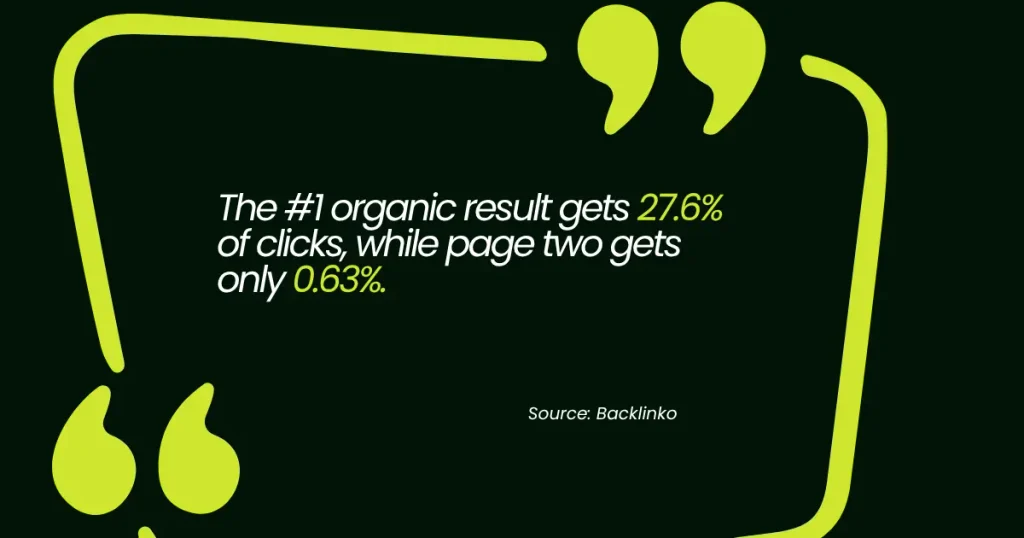
Every position gained dramatically alters your traffic trajectory. Backlinko’s analysis of 4 million search results reveals that the top organic spot captures 27.6% of all clicks, while the entirety of page two scraps for a mere 0.63%.
| Ranking Position | Average CTR |
| Position 1 | 27.6% |
| Position 2 | 15.8% |
| Position 3 | 11.0% |
| Position 4 | 8.0% |
| Position 5 | 7.2% |
| Position 6-10 | Under 5% each |
| Page 2 (11-20) | 0.63% combined |
These numbers show why even a small climb up the results page carries so much weight. Improving SEO keyword ranking means getting a specific page higher in Google’s organic results for a target search term, rather than boosting overall site traffic alone. A page can gain more visibility and conversions without reaching the top spot.
Moving from position 14 to position 8, for example, can bring a noticeable traffic increase. And the biggest improvements usually come from four areas working together: technical SEO, on-page relevance, search intent, and authority built through backlinks and internal links.
7 Steps on How to Improve SEO Keyword Ranking
Pages don’t climb the search results by accident or through a single magic tweak. Real traffic gains happen when small, focused improvements build on each other to send the right signals to Google. The easiest way to get immediate traction is to tap into the momentum your content already has.
1. Audit Your Current Rankings and Find Quick Wins
Start by identifying the keywords your page already ranks for using Google Search Console or a rank-tracking tool like Ahrefs or Semrush. From there, focus first on keywords sitting in positions five through 15, since these pages are already showing enough relevance and authority to compete for stronger positions. These are the opportunities worth prioritizing:
- Keywords ranking in positions 5–15: These are often the strongest quick-win opportunities because the page is already close to the top of the results.
- Keywords with meaningful search demand: Prioritize terms that can bring relevant traffic rather than focusing only on ranking position.
- Pages with room for improvement: Look for pages where stronger content, better search intent alignment, or improved on-page optimization could help push the ranking higher.
- Keywords closely related to the page topic: These can reveal content gaps or opportunities to expand sections without forcing unrelated terms into the copy.
A page moving from position 9 to position 4 usually requires far less work than a brand-new page moving from position 40 to position 10. So you should always start with the pages that already have a foundation, then refine the areas that can make the biggest difference.
Our breakdown of keyword research fundamentals covers how to identify these terms before touching the page itself, and the Semrush keyword research tutorial shows how to filter for search volume and difficulty when building that list.
2. Match the Content to Search Intent
Pull up the top five ranking pages for your target keyword and examine the format, depth, and information they provide. You may find listicles, comparison pages, definitions, product pages, or detailed how-to guides. These results provide useful clues about what Google considers relevant for the search.
For example, your target keyword is “how to improve SEO keyword ranking.” If most of the top-ranking pages provide step-by-step instructions, a short definition of keyword ranking is unlikely to satisfy the same search intent. Your page should explain the process, provide actionable steps, and answer the practical questions readers are likely to have. You can compare your page with the leading results across these areas:
| Area | What to Check |
| Content format | Does your page use the format that dominates the search results? |
| Topics covered | Are competitors answering important questions your page has overlooked? |
| Depth of information | Does your content explain the topic with enough detail to help readers take action? |
| Search intent | Does each section address what someone searching for the keyword is actually trying to accomplish? |
If the competing pages explain how to improve rankings through keyword research, on-page optimization, internal linking, technical SEO, and backlinks, a page that only discusses keyword placement may leave important parts of the search intent unanswered.
Google has already identified patterns in the results that satisfy searchers for the target term. Aligning your content with those expectations gives the page a stronger chance to compete. To close that gap, rewrite sections that answer a different question and add useful information where competing pages reveal a clear content gap.
3. Optimize the On-Page Elements
Once you know which keyword you want the page to rank for, optimize the elements that help search engines and readers understand what the page covers. The target keyword should appear naturally in important areas without being repeated unnecessarily.
| On-Page Element | How to Optimize It |
| Title tag | Include the primary keyword naturally, preferably near the beginning of the title. For example, a page targeting “how to improve SEO keyword ranking” could use “How to Improve SEO Keyword Ranking: 7 Practical Steps.” |
| Introduction | Mention the primary keyword naturally within the opening section so readers immediately understand the page topic. The introduction should also explain what the reader can expect to learn. |
| Headings | Include the target keyword or a closely related variation in an H2 when it accurately describes the section. There is no need to repeat the exact keyword in every heading. |
| URL slug | Keep the URL short and closely related to the main topic. For this article, /how-to-improve-seo-keyword-ranking/ clearly communicates what the page covers. |
| Image alt text | Describe what the image actually shows and include the target keyword when it naturally fits the description. For example, an image showing a keyword ranking report could use “SEO keyword ranking report in Google Search Console” rather than forcing the exact keyword into unrelated image descriptions. |
| Meta description | Summarize the page clearly and give readers a reason to click. Aim for around 145 to 155 characters, while keeping the description natural and informative. |
Working with natural keyword variations like “improve keyword rankings,” “increase search rankings,” and “rank higher in Google” helps you show up for a wider pool of searches. This keeps your writing smooth and easy to read while keeping you far away from the risks of keyword stuffing.
4. Strengthen Internal Linking
Beyond the on-page elements, internal links also help signal relevance. Link to the page from other relevant, higher-authority pages on your site, and use descriptive anchor text so readers and search engines understand what the linked page covers.
For example, if your target page is “how to improve SEO keyword ranking,” you could:
- Link from a keyword research article: Use anchor text such as “how to improve SEO keyword ranking” when discussing what happens after finding your target keywords.
- Link from an on-page SEO article: Add the link when explaining how content optimization can help improve search visibility.
- Link from a related SEO guide: Connect the pages when the target article provides a useful next step for the reader.
- Avoid generic anchor text: Replace phrases such as “click here” with descriptive text that tells readers what they will find after clicking.
Relevant internal links help Google understand how your pages connect and which page should rank for a particular topic. They also give readers a clearer path to related information.
5. Fix Technical SEO Issues Holding the Page Back
Technical issues can limit a page’s ability to rank, even when the content itself is strong. Start by confirming that Google can crawl and index the page, then check its mobile loading performance and look for duplicate or near-duplicate pages targeting the same keyword. These checks help ensure that search engines can access the page and understand which URL should rank.
Structured data is another useful technical element when it accurately matches the content on the page. Schema markup gives search engines additional context about information such as articles, services, products, or other supported content types. It can also make eligible pages more likely to appear with enhanced search features.
6. Build Relevant Backlinks
Backlinks can strengthen a page’s authority, particularly when they come from relevant websites that already cover the same subject area. Focus on earning links that make sense in context rather than trying to collect as many links as possible.
| Backlink Approach | How It Helps | What to Focus On |
| Guest contributions | Places your content on relevant industry websites | Share useful, original insights and link to a related resource |
| Original research or data | Gives other websites a reason to reference your findings | Publish statistics, surveys, studies, or industry insights |
| Targeted outreach | Connects useful content with websites covering the same topic | Reach out when your resource adds genuine value |
| Industry resources | Places your content alongside other trusted resources | Prioritize reputable websites with strong topical relevance |
| Low-quality directories | Often provide little relevance or editorial value | Avoid relying on large volumes of generic directory links |
A relevant backlink from an established industry publication can carry more value than dozens of unrelated directory links. The strongest opportunities usually come from websites where the link fits naturally within useful content and gives readers additional information. This makes relevance and editorial quality more important than backlink volume alone.
7. Track Results and Refine
SEO changes rarely produce immediate, consistent movement. Rankings can fluctuate after an update as Google recrawls the page and reassesses its relevance against competing results. Track performance regularly so you can identify meaningful trends instead of reacting to daily changes.
- Check rankings every one to two weeks. Monitor the target keyword along with related terms already bringing impressions or clicks to the page.
- Compare performance over time. Look at changes in average position, impressions, clicks, and click-through rate in Google Search Console. A ranking improvement has more value when it also leads to stronger search visibility and traffic.
- Give changes enough time to work. Avoid making several major changes at once. Allow around three to four weeks before evaluating the initial impact, particularly when the page already has ranking history.
- Investigate stalled rankings. If a keyword has not improved after six to eight weeks, review the page against the current search results. Check search intent first, then look at content depth, internal links, on-page optimization, and competing pages.
- Refine based on the data. Keep the changes that improve performance and revisit areas that remain weak. SEO works as an ongoing process, so ranking gains often come from repeated testing and refinement rather than a single optimization.
Which SEO Ranking Improvements Should You Prioritize First?
Not every SEO fix delivers the same impact or produces results at the same pace. Some improvements can influence rankings within a few weeks, while others require more time and sustained effort. Prioritizing your efforts based on potential impact and expected timeframe can help you focus on the opportunities most likely to move the needle.
| Action | Typical Effort | Time to See Movement | Best For |
| On-page keyword placement (title, H2, first 100 words) | Low | 1–3 weeks | Pages already ranking 5–15 |
| Internal linking from relevant pages | Low | 2–4 weeks | New and existing pages |
| Content rewrite to match search intent | Medium | 4–8 weeks | Pages stuck outside page 1 |
| Schema markup and structured data | Medium | 2–6 weeks | Pages competing for rich results |
| Site speed and mobile fixes | Medium–High | 4–8 weeks | Sitewide ranking plateaus |
| Backlink outreach | High | 8–16 weeks | Competitive, high-difficulty keywords |
Turn Your SEO Opportunities Into Ranking Gains
Pages already ranking on page two can start moving within two to four weeks after targeted on-page and internal linking improvements. New pages and highly competitive keywords can take three to six months to gain traction.
Finding the right ranking opportunities can bring in a ton of new traffic, but turning those chances into actual rankings takes constant work across content updates, on-page fixes, and link building.
Without steady focus, great pages often stay stuck right below where the real traffic lives. Contacting a professional SEO team like Sam SEO Philippines takes the guesswork out of the process, helping you turn hidden search potential into steady ranking gains.
Frequently Asked Questions
How long does it take to improve SEO keyword ranking?
Most pages show early movement within two to four weeks after on-page fixes and internal links go live, especially for keywords already sitting in positions five through 15. Brand-new pages or highly competitive terms usually take three to six months, since Google needs time to recrawl the page, register the updated signals, and weigh them against every other page competing for that term. Site authority plays a role too. A page on an established, well-linked domain tends to move faster than the same content on a brand-new site. Track progress every one to two weeks rather than daily, since day-to-day fluctuation in Google’s results is normal and rarely reflects the actual trend.
What is the fastest way to increase keyword ranking?
The fastest gains usually come from optimizing pages that already rank in positions five through 15, often called striking-distance keywords. These pages already have enough relevance and authority to compete on page one; they typically need a stronger title tag, a rewritten introduction that matches search intent more closely, and a few internal links from related pages on the site. Because Google has already indexed and trusts these pages to some degree, small refinements can produce a ranking jump within a few weeks. Chasing brand-new keywords from scratch takes considerably longer, since the page has to earn relevance and authority signals before it can compete for page one.
Do I need backlinks to improve keyword rankings, or is content enough?
Strong content and clean on-page optimization can improve keyword rankings for low and medium competition terms without new backlinks, particularly if the page already sits on an established site with decent internal linking. For competitive, high-volume keywords, backlinks still carry real weight, since they signal to Google that other sites consider the page trustworthy enough to reference. The safest approach treats backlinks as one input among several rather than the only lever. Fix on-page relevance and search intent first, since a page with strong content and a handful of relevant links regularly outperforms a page with dozens of low-quality links and thin content.
Can I improve keyword ranking without changing the page’s URL?
Yes, and in most cases the URL should stay untouched once a page has earned rankings, backlinks, and indexed history. Changing a URL that already ranks risks a temporary drop while Google recrawls and re-evaluates the new address, even with a proper redirect in place. Ranking improvements typically come from editing the content, title tag, meta description, headings, and internal links rather than the URL itself. The URL slug matters most when a page is brand new and has no ranking history to protect, since that is the point where including the target keyword in the slug carries the least risk.
How often should I check my keyword rankings after making changes?
Checking once every one to two weeks gives a clearer picture than checking daily, since Google’s rankings shift constantly due to factors unrelated to any single page, including algorithm updates, seasonal search behavior, and competitor changes. Daily checks tend to create noise that makes it hard to tell whether a specific fix worked. Give a change at least three to four weeks before judging its impact, and compare the keyword against its own history rather than a single snapshot. For pages targeting highly competitive terms, tracking monthly alongside a broader look at organic traffic in Google Search Console gives a more reliable read than rank position alone.